Free International Shipping. No Minimum Purchase Required*

How to find us  |  Gift vouchers

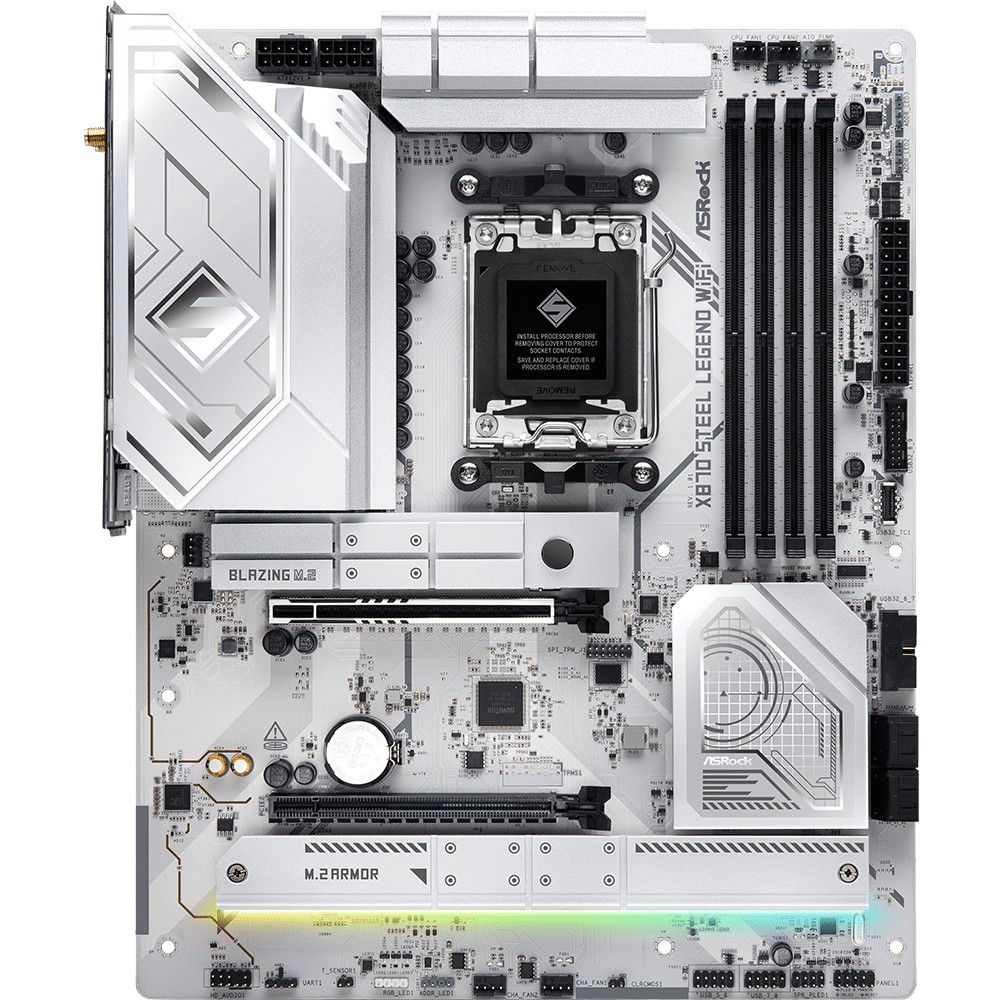
ASRock X870 Steel Legend WiFi AM5 ATX HDMI/USB-C DDR5 retail

  • AMD Socket AM5 AMD Ryzen™ 7, AMD Ryzen™ 9
  • PC ATX AMD X870 7.1 channels
  • DDR5-SDRAM 4 DIMM Maximum internal memory: 256 GB
  • RAID support
  • BIOS type: UEFI AMI 256 Mbit
  • 2.5 Gigabit Ethernet Wi-Fi Wi-Fi 7 (802.11be) Bluetooth 5.4

316.25

Product information

  • AMD Socket AM5 AMD Ryzen™ 7, AMD Ryzen™ 9
  • PC ATX AMD X870 7.1 channels
  • DDR5-SDRAM 4 DIMM Maximum internal memory: 256 GB
  • RAID support
  • BIOS type: UEFI AMI 256 Mbit
  • 2.5 Gigabit Ethernet Wi-Fi Wi-Fi 7 (802.11be) Bluetooth 5.4

Product Specifications

Specs

Processor
Processor manufacturer
The manufacturer that produced the processor.
AMD
Processor socket
Mechanical component(s) that provides mechanical and electrical connections between a microprocessor and a printed circuit board (PCB). This allows the processor to be replaced without soldering.
Socket AM5
Compatible processor series
A processor which is compatible with this device, belongs to a 'series' which is part of 'family' e.g Celeron D, Celeron G, Celeron M, or, in some cases, is the same as 'family'.
AMD Ryzen™ 7, AMD Ryzen™ 9
Memory
Supported memory types
Types of memory which can be used with the product.
DDR5-SDRAM
Number of memory slots
4
Memory slots type
A memory slot, also known as a memory socket or RAM slot, is what allows computer memory (RAM) to be inserted into the computer. Depending on the motherboard, there will usually be 2 to 4 memory slots (sometimes more on high-end motherboards). The most common types of RAM are SDRAM and DDR for desktop computers and SODIMM for laptop computers, each having various types and speeds.
DIMM
Memory channels
Dual-channel
ECC сompatibility
ECC & Non-ECC
Maximum internal memory
The maximum internal memory which is available in the product.
256 GB
Storage controllers
RAID support
The device uses RAID, which is a storage technology that combines multiple disk drive components into a logical unit for the purposes of data redundancy and performance improvement. Data is distributed across the drives in one of several ways, referred to as RAID levels, depending on the specific level of redundancy and performance required.
RAID levels
RAID is a storage technology that combines multiple disk drive components into a logical unit for the purposes of data redundancy and performance improvement. Data is distributed across the drives in one of several ways, referred to as RAID levels, depending on the specific level of redundancy and performance required.
0, 1, 10
Internal I/O
USB 2.0 connectors
The end of a cable with a USB 2.0 connector. USB 2.0 was released in April 2000 (now called "Hi-Speed"), adding higher maximum signaling rate of 480 Mbit/s (effective throughput up to 35 MB/s or 280 Mbit/s), in addition to the "USB 1.x Full Speed" signaling rate of 12 Mbit/s. USB 2.0 connectors are usually colored black.
2
USB 3.2 Gen 1 (3.1 Gen 1) connectors
This is a connector (normally attached to a cable) for USB 3.0. USB 3.0 is the second major revision of the Universal Serial Bus (USB) standard for computer connectivity. First introduced in 2008, USB 3.0 adds a new transfer mode called "SuperSpeed," (distinguishable from USB 2.0 by either the blue colour of the port or the initials SS) capable of transferring data at up to 5Gbit/s—more than ten times as fast as the 480 Mbit/s top speed of USB 2.0.
2
USB 3.2 Gen 2 (3.1 Gen 2) connectors
1
Number of SATA III connectors
Serial ATA (Advanced Technology Attachment) (SATA) is a computer bus interface that connects host bus adapters to mass storage devices such as hard disk drives and optical drives. SATA III (revision 3.x) interface, formally known as SATA 6Gb/s, is a third generation SATA interface running at 6.0Gb/s. The bandwidth throughput, which is supported by the interface, is up to 600MB/s. This interface is backwards compatible with SATA 3 Gb/s interface.
4
Front panel audio connector
ATX Power connector (24-pin)
CPU fan connector
Number of chassis fan connectors
3
RGB LED pin header
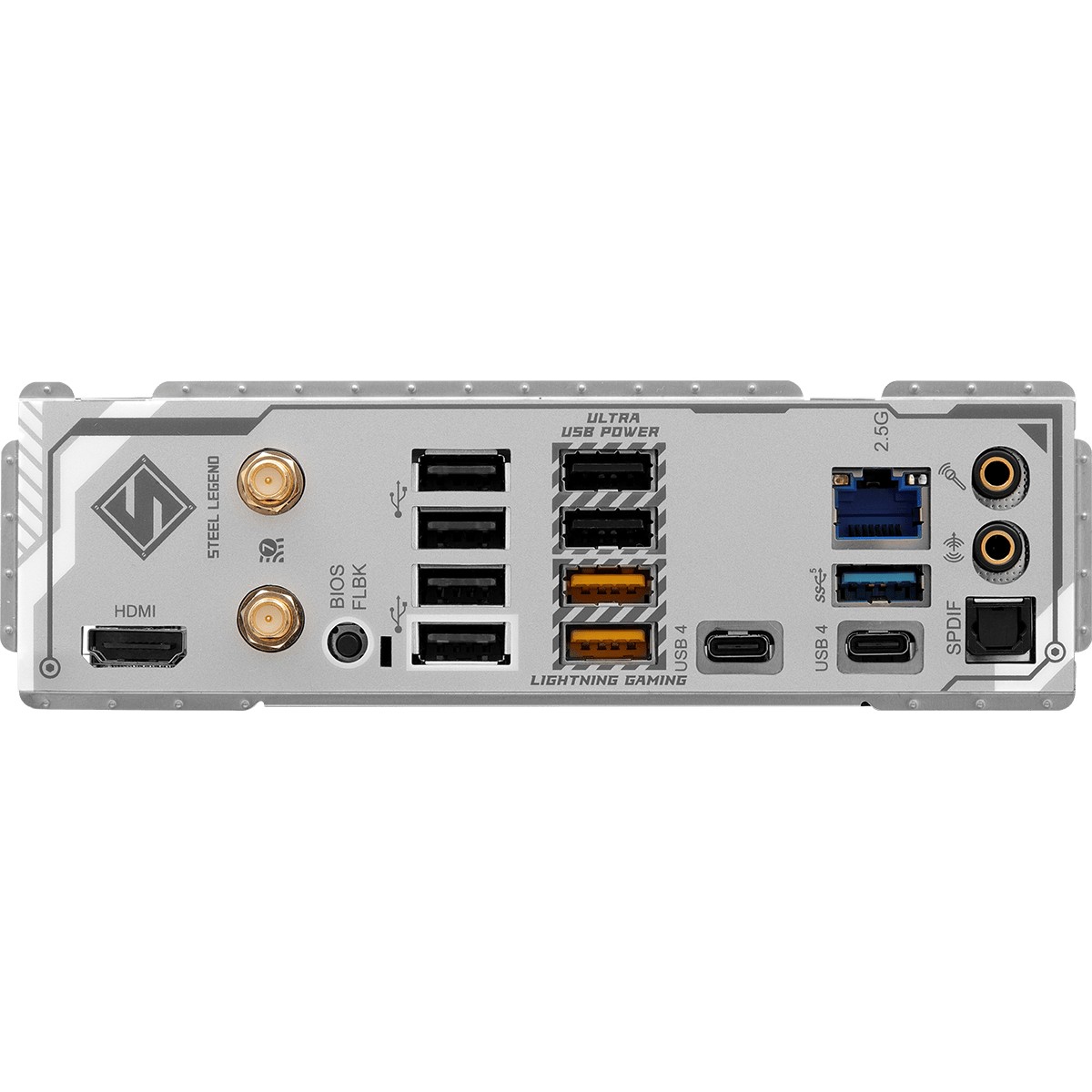
Rear panel I/O ports
USB 2.0 ports quantity
Number of USB 2.0 ports (connecting interfaces) in the device. USB 2.0 was released in April 2000 (now called "Hi-Speed"), adding higher maximum signaling rate of 480 Mbit/s (effective throughput up to 35 MB/s or 280 Mbit/s), USB 2.0 ports are usually black.
4
USB 3.2 Gen 1 (3.1 Gen 1) Type-A ports quantity
3
USB 3.2 Gen 2 (3.1 Gen 2) Type-A ports quantity
2
USB4 Gen 3x2 ports quantity
4
Ethernet LAN (RJ-45) ports
Number of Ethernet LAN (RJ-45) ports (connecting interfaces) in the device. Ethernet LAN (RJ-45) ports allow a computer to connect to the ethernet.
1
HDMI ports quantity
The number of sockets (ports) for HDMI connections. HDMI (High-Definition Multimedia Interface) is a compact audio/video interface for transferring uncompressed video data and compressed/uncompressed digital audio data from a HDMI-compliant device ("the source device") to a compatible computer monitor, video projector, digital television, or digital audio device. HDMI is a digital replacement for existing analog video standards.
1
Rear panel I/O ports
Microphone in
The socket where a microphone is connected to the device.
S/PDIF out port
S/PDIF (Sony/Philips Digital Interconnect Format) is a digital audio interconnect used in consumer audio equipment over relatively short distances. The signal is transmitted over either a coaxial cable with RCA connectors or a fibre optic cable with TOSLINK connectors.
Network
Ethernet LAN
An Ethernet LAN (Local Area Network) interface is present, for a wired conection via a cable.
Ethernet interface type
2.5 Gigabit Ethernet
LAN controller
Realtek RTL8125-BG
Wi-Fi
Popular technology that allows an electronic device to exchange data or connect to the internet wirelessly using radio waves.
Top Wi-Fi standard
Connection of this device is done via Wi-Fi in a high standard.
Wi-Fi 7 (802.11be)
Wi-Fi standards
The type of wireless local area network (LAN). It can be ad-hoc, where units in a network communicate peer-to-peer, or Infrastructure, where units communicate with each other via an access point A LAN interconnects computers in a small area e.g. home, school or office.
802.11a, 802.11b, 802.11g, Wi-Fi 4 (802.11n), Wi-Fi 5 (802.11ac), Wi-Fi 6 (802.11ax), Wi-Fi 7 (802.11be)
Bluetooth
Bluetooth is a low-power radio technology developed to replace the cables and wires currently used to link or connect electronic devices such as personal computers, printers, and a wide variety of handheld devices including mobile phones. Because it uses radio-wave connectivity, a Bluetooth-enabled device has a constant, established connection to whatever browser it uses. This saves the user the trouble of logging on to check for emails or news updates, for example.
Bluetooth version
The type of bluetooth technology in the product e.g. Bluetooth Smart (v4.0).
5.4
Features
Motherboard chipset
The chipset connects the microprocessor to the rest of the motherboard.
AMD X870
Audio output channels
An audio output channel is an electric circuit which acts as a path for a signal produced by a device. A device may have several audio output channels.
7.1 channels
Component for
What this product is used as a part of (component for).
PC
Motherboard form factor
Design of the motherboard (ATX, BTX etc).
ATX
Motherboard chipset family
The category of motherboard chipset e.g. Intel, AMD.
AMD
Windows operating systems supported
Windows vesions wich can be used with the device.
Windows 10 x64, Windows 11 x64
Expansion slots
PCI Express x16 (Gen 4.x) slots
1
PCI Express x16 (Gen 5.x) slots
1
Number of M.2 (M) slots
1
BIOS
BIOS type
The BIOS (Basic Input/Output System) initializes and tests system hardware components, and loads a bootloader or an operating system from a mass memory device. The BIOS additionally provides abstraction layer for the hardware, i.e. a consistent way for application programs and operating systems to interact with the keyboard, display, and other input/output devices. There are several types of BIOS, including the motherboard ROM BIOS, video BIOS, drive controller BIOS, network adapter BIOS, and SCSI adapter BIOS.
UEFI AMI
BIOS memory size
256 Mbit
Weight & dimensions
Width
The measurement or extent of something from side to side.
305 mm
Depth
The distance from the front to the back of something.
244 mm

Specs

Processor
Processor manufacturer
The manufacturer that produced the processor.
AMD
Processor socket
Mechanical component(s) that provides mechanical and electrical connections between a microprocessor and a printed circuit board (PCB). This allows the processor to be replaced without soldering.
Socket AM5
Compatible processor series
A processor which is compatible with this device, belongs to a ‘series’ which is part of ‘family’ e.g Celeron D, Celeron G, Celeron M, or, in some cases, is the same as ‘family’.
AMD Ryzen™ 7, AMD Ryzen™ 9
Memory
Supported memory types
Types of memory which can be used with the product.
DDR5-SDRAM
Number of memory slots
4
Memory slots type
A memory slot, also known as a memory socket or RAM slot, is what allows computer memory (RAM) to be inserted into the computer. Depending on the motherboard, there will usually be 2 to 4 memory slots (sometimes more on high-end motherboards). The most common types of RAM are SDRAM and DDR for desktop computers and SODIMM for laptop computers, each having various types and speeds.
DIMM
Memory channels
Dual-channel
ECC сompatibility
ECC & Non-ECC
Maximum internal memory
The maximum internal memory which is available in the product.
256 GB
Storage controllers
RAID support
The device uses RAID, which is a storage technology that combines multiple disk drive components into a logical unit for the purposes of data redundancy and performance improvement. Data is distributed across the drives in one of several ways, referred to as RAID levels, depending on the specific level of redundancy and performance required.
RAID levels
RAID is a storage technology that combines multiple disk drive components into a logical unit for the purposes of data redundancy and performance improvement. Data is distributed across the drives in one of several ways, referred to as RAID levels, depending on the specific level of redundancy and performance required.
0, 1, 10
Internal I/O
USB 2.0 connectors
The end of a cable with a USB 2.0 connector. USB 2.0 was released in April 2000 (now called “Hi-Speed”), adding higher maximum signaling rate of 480 Mbit/s (effective throughput up to 35 MB/s or 280 Mbit/s), in addition to the “USB 1.x Full Speed” signaling rate of 12 Mbit/s. USB 2.0 connectors are usually colored black.
2
USB 3.2 Gen 1 (3.1 Gen 1) connectors
This is a connector (normally attached to a cable) for USB 3.0. USB 3.0 is the second major revision of the Universal Serial Bus (USB) standard for computer connectivity. First introduced in 2008, USB 3.0 adds a new transfer mode called “SuperSpeed,” (distinguishable from USB 2.0 by either the blue colour of the port or the initials SS) capable of transferring data at up to 5Gbit/s—more than ten times as fast as the 480 Mbit/s top speed of USB 2.0.
2
USB 3.2 Gen 2 (3.1 Gen 2) connectors
1
Number of SATA III connectors
Serial ATA (Advanced Technology Attachment) (SATA) is a computer bus interface that connects host bus adapters to mass storage devices such as hard disk drives and optical drives. SATA III (revision 3.x) interface, formally known as SATA 6Gb/s, is a third generation SATA interface running at 6.0Gb/s. The bandwidth throughput, which is supported by the interface, is up to 600MB/s. This interface is backwards compatible with SATA 3 Gb/s interface.
4
Front panel audio connector
ATX Power connector (24-pin)
CPU fan connector
Number of chassis fan connectors
3
RGB LED pin header
Rear panel I/O ports
USB 2.0 ports quantity
Number of USB 2.0 ports (connecting interfaces) in the device. USB 2.0 was released in April 2000 (now called “Hi-Speed”), adding higher maximum signaling rate of 480 Mbit/s (effective throughput up to 35 MB/s or 280 Mbit/s), USB 2.0 ports are usually black.
4
USB 3.2 Gen 1 (3.1 Gen 1) Type-A ports quantity
3
USB 3.2 Gen 2 (3.1 Gen 2) Type-A ports quantity
2
USB4 Gen 3×2 ports quantity
4
Ethernet LAN (RJ-45) ports
Number of Ethernet LAN (RJ-45) ports (connecting interfaces) in the device. Ethernet LAN (RJ-45) ports allow a computer to connect to the ethernet.
1
HDMI ports quantity
The number of sockets (ports) for HDMI connections. HDMI (High-Definition Multimedia Interface) is a compact audio/video interface for transferring uncompressed video data and compressed/uncompressed digital audio data from a HDMI-compliant device (“the source device”) to a compatible computer monitor, video projector, digital television, or digital audio device. HDMI is a digital replacement for existing analog video standards.
1
Rear panel I/O ports
Microphone in
The socket where a microphone is connected to the device.
S/PDIF out port
S/PDIF (Sony/Philips Digital Interconnect Format) is a digital audio interconnect used in consumer audio equipment over relatively short distances. The signal is transmitted over either a coaxial cable with RCA connectors or a fibre optic cable with TOSLINK connectors.
Network
Ethernet LAN
An Ethernet LAN (Local Area Network) interface is present, for a wired conection via a cable.
Ethernet interface type
2.5 Gigabit Ethernet
LAN controller
Realtek RTL8125-BG
Wi-Fi
Popular technology that allows an electronic device to exchange data or connect to the internet wirelessly using radio waves.
Top Wi-Fi standard
Connection of this device is done via Wi-Fi in a high standard.
Wi-Fi 7 (802.11be)
Wi-Fi standards
The type of wireless local area network (LAN). It can be ad-hoc, where units in a network communicate peer-to-peer, or Infrastructure, where units communicate with each other via an access point A LAN interconnects computers in a small area e.g. home, school or office.
802.11a, 802.11b, 802.11g, Wi-Fi 4 (802.11n), Wi-Fi 5 (802.11ac), Wi-Fi 6 (802.11ax), Wi-Fi 7 (802.11be)
Bluetooth
Bluetooth is a low-power radio technology developed to replace the cables and wires currently used to link or connect electronic devices such as personal computers, printers, and a wide variety of handheld devices including mobile phones. Because it uses radio-wave connectivity, a Bluetooth-enabled device has a constant, established connection to whatever browser it uses. This saves the user the trouble of logging on to check for emails or news updates, for example.
Bluetooth version
The type of bluetooth technology in the product e.g. Bluetooth Smart (v4.0).
5.4
Features
Motherboard chipset
The chipset connects the microprocessor to the rest of the motherboard.
AMD X870
Audio output channels
An audio output channel is an electric circuit which acts as a path for a signal produced by a device. A device may have several audio output channels.
7.1 channels
Component for
What this product is used as a part of (component for).
PC
Motherboard form factor
Design of the motherboard (ATX, BTX etc).
ATX
Motherboard chipset family
The category of motherboard chipset e.g. Intel, AMD.
AMD
Windows operating systems supported
Windows vesions wich can be used with the device.
Windows 10 x64, Windows 11 x64
Expansion slots
PCI Express x16 (Gen 4.x) slots
1
PCI Express x16 (Gen 5.x) slots
1
Number of M.2 (M) slots
1
BIOS
BIOS type
The BIOS (Basic Input/Output System) initializes and tests system hardware components, and loads a bootloader or an operating system from a mass memory device. The BIOS additionally provides abstraction layer for the hardware, i.e. a consistent way for application programs and operating systems to interact with the keyboard, display, and other input/output devices. There are several types of BIOS, including the motherboard ROM BIOS, video BIOS, drive controller BIOS, network adapter BIOS, and SCSI adapter BIOS.
UEFI AMI
BIOS memory size
256 Mbit
Weight & dimensions
Width
The measurement or extent of something from side to side.
305 mm
Depth
The distance from the front to the back of something.
244 mm

Customer Reviews

Add a review
ASRock X870 Steel Legend WiFi AM5 ATX HDMI/USB-C DDR5 retail ASRock X870 Steel Legend WiFi AM5 ATX HDMI/USB-C DDR5 retail
Rating*
0/5
* Rating is required
Your review
* Review is required
Name
* Name is required
0.0
Based on 0 reviews
5 star
0%
4 star
0%
3 star
0%
2 star
0%
1 star
0%
0 of 0 reviews

Sorry, no reviews match your current selections

Accessories

Questions & Answers

Q & A

Ask a question
You must be logged in to ask a question Log In
There are no questions yet

Delivery & Returns

We aim to deliver your order quickly and safely.

  • Standard delivery: 3–6 working days within Ireland.

  • Click & Collect: Available free from our Clonakilty store (you will be notified when your order is ready).

  • If an item is out of stock, we will contact you with an updated delivery timeframe or alternative options.

  • Delivery charges are calculated at checkout based on order size and destination.

Warranty

All products sold by Computronic come with a standard manufacturer’s warranty. Warranty length and coverage may vary by product and brand. For most electronics, this is 12 months from the date of purchase. Please keep your receipt or order confirmation as proof of purchase.

  • Warranty covers manufacturing defects and hardware faults.

  • It does not cover accidental damage, misuse, or normal wear and tear.

  • For warranty claims, please contact us or bring the product to our Clonakilty store.

Buy with

Whats in the box